
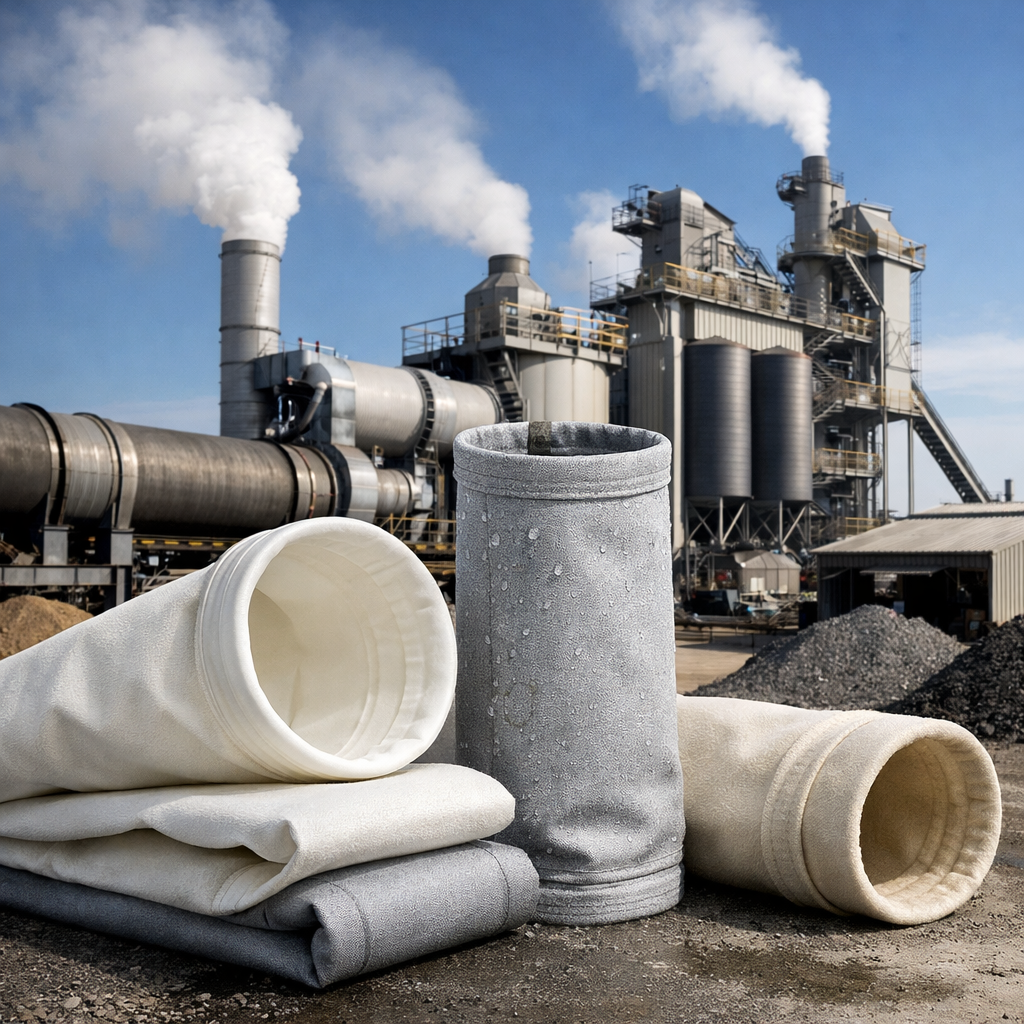
Asphalt Mixing Plant – How to Choose the Right Filter Bags
If you run an asphalt mixing plant, you know that dust control is not just about keeping the workplace clean — it’s about staying compliant, protecting equipment, and avoiding costly downtime. At the heart of your dust collection system are the filter bags. Choosing the wrong ones can lead to frequent bag changes, high pressure drops, and even emissions violations.
So, how do you choose the right filter bags for an asphalt mixing plant? Let’s break it down.
1. Understand the Dust Conditions in Asphalt Plants
Asphalt plant flue gas is different from other industries. It has several unique characteristics:
- High moisture content – Aggregates are often dried with heat, releasing steam.
- Sticky dust – Fine particles mixed with bitumen vapors can be tacky.
- Moderate to high temperatures – Typically 120°C to 180°C, with occasional spikes.
- Abrasive particles – Sand, stone dust, and other aggregates wear down bags over time.
Because of these conditions, not every filter bag works well in an asphalt plant.
2. Key Factors to Consider When Choosing Filter Bags
🔥 Heat Resistance
Your filter bags must withstand continuous operating temperatures. For most asphalt plants, the bag material should handle at least 150°C to 180°C.
Common material choices:
| Material | Max Continuous Temp | Good for Asphalt? |
|---|---|---|
| Polyester | 130°C | ❌ Too low |
| Acrylic (Homopolymer) | 140°C | ❌ Marginal |
| Aramid (e.g., Nomex®) | 200°C | ✅ Excellent |
| PPS | 190°C | ✅ Good, but less chemical resistance |
| PTFE | 260°C | ✅ Best, but higher cost |
✅ Recommendation: Aramid (Nomex®) is the most popular and cost-effective choice for asphalt mixing plants.
🧼 Anti-Stick Property (Release of Sticky Dust)
Bitumen vapors can make dust stick to the bag surface. This causes clogging and high pressure drop.
- Look for: Smooth surface finish, calendered fabric, or PTFE coating.
- Avoid: Standard felt without any surface treatment — they will blind quickly.
✅ Tip: A PTFE membrane on top of Aramid felt works very well for sticky asphalt dust.
🧪 Chemical Resistance
Asphalt flue gas may contain small amounts of sulfur oxides (SO₂) and other acidic gases. Over time, these attack the bag fibers.
- Polyester is easily damaged by acid.
- Aramid has moderate acid resistance but should not be used with strong acid.
- PTFE is chemically inert but expensive.
✅ Recommendation: For most asphalt plants, Aramid is good enough. If acid is a known problem, consider a PTFE-coated Aramid or pure PTFE.
🧲 Filtration Efficiency (Meeting Local Emission Limits)
Different countries have different legal limits:
| Region | Typical Dust Limit |
|---|---|
| Europe | < 10 mg/Nm³ |
| China | < 20–30 mg/Nm³ |
| USA | < 0.04 lb/MMBtu (case by case) |
| India | < 50 mg/Nm³ for older plants |
To achieve low emissions, you need high-efficiency felt (e.g., needle-punched or spunlace) and proper bag sealing.
3. Common Mistakes to Avoid
❌ Using Polyester bags – They fail quickly under asphalt plant temperatures.
❌ Ignoring moisture – Wet dust hardens into concrete-like cakes on bags.
❌ Buying only by price – Cheap bags fail in 3–6 months. Good bags last 12–24 months.
❌ Forgetting installation quality – Even the best bag fails if it is not fitted tightly.
4. Our Recommended Filter Bag Solutions for Asphalt Plants
Based on our experience working with dozens of asphalt mixing plants, here is what we recommend:
| Plant Type | Recommended Bag Material | Surface Treatment | Expected Life |
|---|---|---|---|
| Standard asphalt plant | Aramid (Nomex®) | Calendered | 12–18 months |
| High-moisture / sticky dust | Aramid + PTFE membrane | PTFE membrane | 18–24 months |
| High-acid condition | PTFE (100%) | PTFE membrane | 24–36 months |
| Budget but acceptable | Acrylic + PTFE coating | PTFE coating | 6–12 months |
✅ Our most popular combination: Aramid felt with PTFE membrane — great balance of performance, life, and cost.
5. Maintenance Tips to Extend Bag Life
Even the best filter bags need care. Follow these tips:
- Check pressure drop daily – A sudden rise means clogging or broken bags.
- Inspect bags every 3 months – Look for holes, hardening, or sticky buildup.
- Replace in sets – Mixing old and new bags reduces overall performance.
- Control gas temperature – Avoid spikes above 200°C, even for short times.
- Use proper pulse cleaning – Too strong = bag damage. Too weak = clogging.
6. Why Choose Us for Your Asphalt Plant Filter Bags?
- ✅ We specialize in high-temperature, sticky dust applications
- ✅ Free material recommendation based on your plant’s fuel and aggregate
- ✅ Custom sizes – we fit any brand of dust collector
- ✅ Sample testing available before bulk order
- ✅ Fast delivery and technical support
Final Summary
Choosing the right filter bag for your asphalt mixing plant comes down to three things:
- Temperature – Choose Aramid or PTFE, not Polyester.
- Sticky dust – Use a PTFE membrane or smooth finish.
- Compliance – Match bag efficiency to your local emission law.
Still not sure? Send us your plant’s operating conditions (temperature, fuel type, moisture level), and we will recommend the best filter bag for you — at no charge.
Contact us today to keep your asphalt plant running clean and compliant.