
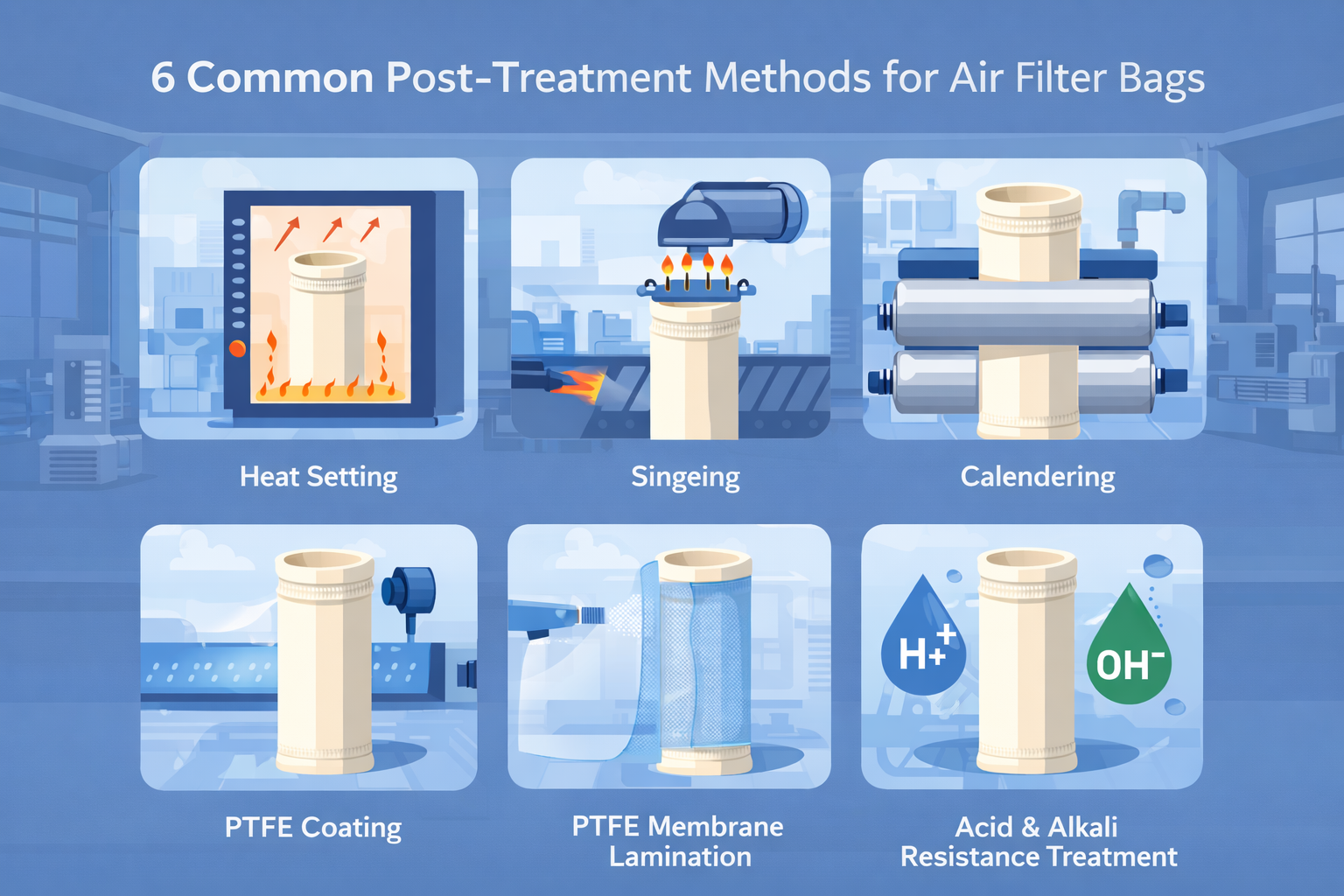
Common Post-Treatments for Air Filter Bags – What They Do and Why They Matter
When you buy an air filter bag, what you see on the outside is not the whole story. The base fabric (felt or woven material) is just the starting point. To make the bag perform well in real-world conditions — high temperature, sticky dust, moisture, or chemicals — manufacturers apply post-treatments.
These post-treatments can mean the difference between a bag that lasts 6 months and one that lasts 24 months.
In this blog, we will look at the most common post-treatments for air filter bags, what they do, and when you should choose each one.
1. Why Do Filter Bags Need Post-Treatment?
A raw, untreated filter bag has several problems:
- Fibers are loose and can shed
- Dust sticks to the surface easily
- Poor resistance to moisture and chemicals
- Low filtration efficiency at the start
Post-treatments solve these problems by:
| Problem | Post-Treatment Solution |
|---|---|
| Loose fibers | Heat setting, singeing |
| Dust sticking | Calendering, PTFE coating, membrane lamination |
| Moisture damage | Water-repellent treatment |
| Chemical attack | Anti-acid / anti-alkali treatment |
| Low efficiency | Membrane lamination, antistatic treatment |
Now let us go through each post-treatment one by one.
2. Common Post-Treatments – The Complete List
Below is a table of the most widely used post-treatments for air filter bags in industries like cement, steel, power plants, asphalt, and boilers.
| Post-Treatment | What It Does | Best For | Typical Industries |
|---|---|---|---|
| Heat setting | Locks fibers in place, improves dimensional stability | All bag types | All industries |
| Singeing | Burns off loose surface fibers for a smooth finish | Dust cake release | Cement, asphalt, boiler |
| Calendering | Presses and smooths the fabric surface | Reducing dust adhesion | Asphalt, food, chemical |
| PTFE coating | Adds a thin PTFE layer on the surface | Sticky dust, high efficiency | Asphalt, incinerator, boiler |
| PTFE membrane lamination | Bonds a microporous PTFE film to the fabric | Ultra-high efficiency (<10 mg/Nm³) | Power plants, cement, waste-to-energy |
| Water-repellent treatment | Prevents moisture absorption | High humidity or condensation risk | Drying processes, asphalt, sludge incineration |
| Anti-acid treatment | Protects against sulfur oxides (SO₂, SO₃) | Acidic flue gas | Boiler, power plant, chemical plant |
| Anti-alkali treatment | Protects against alkaline dust | Cement, lime, mining | Cement kilns, lime plants |
| Antistatic treatment | Prevents static charge buildup | Explosive or combustible dust | Coal mills, grain, wood, chemical powder |
| Oil-repellent treatment | Resists oil mist and oily dust | Metalworking, engine test cells | Automotive, machining |
3. Detailed Look at the Most Important Post-Treatments
Let us go deeper into the five most common post-treatments you will encounter.
🔥 Heat Setting
How it works: The bag fabric is heated to a specific temperature while being held under tension. This relaxes internal stresses from the needling or weaving process.
Benefits:
- Bags do not shrink or stretch during operation
- Maintains consistent size and shape
- Better mechanical stability
When to choose: Always. Heat setting is a standard step for almost all high-quality filter bags.
🔥 Singeing
How it works: The fabric passes quickly over an open flame or heated plate. Surface fibers are burned off, leaving a cleaner, smoother surface.
Benefits:
- Dust releases more easily during pulse cleaning
- Prevents surface felting and blinding
- Slightly improves initial efficiency
When to choose: Any application with fine or sticky dust. Very common in asphalt and cement plants.
🔥 Calendering
How it works: The fabric is passed between two heated rollers under high pressure. The surface is pressed flat and smooth.
Benefits:
- Very smooth surface — dust has little to grab onto
- Reduces pressure drop
- Improves cake release
Difference from singeing:
| Feature | Singeing | Calendering |
|---|---|---|
| Method | Flame | Pressure + heat |
| Surface effect | Removes loose fibers | Flattens and compresses |
| Air permeability | Slightly reduced | More reduced |
| Best for | Sticky dust | Very sticky dust / high moisture |
🔥 PTFE Coating vs. PTFE Membrane Lamination
These two are often confused. Here is the difference:
| Feature | PTFE Coating | PTFE Membrane Lamination |
|---|---|---|
| Thickness | Very thin (few microns) | Thin but thicker than coating |
| Application | Sprayed or rolled on | Bonded as a separate film |
| Efficiency | Good | Excellent (<10 mg/Nm³) |
| Air permeability | Moderate reduction | Higher reduction |
| Cost | Lower | Higher |
| Best for | Moderate sticky dust | High efficiency requirements |
When to choose coating: Asphalt plants, dry cement, food processing.
When to choose membrane: Power plants, incinerators, cement kilns, or anywhere with emission limits below 10 mg/Nm³.
🔥 Anti-Acid Treatment
How it works: The fabric is dipped or sprayed with a chemical solution that makes the fibers more resistant to acid attack.
Why it matters: Many industrial flue gases contain sulfur oxides (SO₂, SO₃). When mixed with water vapor, they form sulfuric acid. Over time, acid eats away standard fibers like polyester.
Benefits:
- Longer bag life in acidic conditions
- Prevents brittle failure of fibers
When to choose:
- Coal-fired boilers
- Waste incinerators
- Chemical plants with acid gas
Note: For very severe acid conditions, PTFE fiber is better than any anti-acid treatment on a cheaper fiber.
4. How to Choose the Right Post-Treatment Combination
No single post-treatment does everything. Often, the best filter bag uses two or three treatments together.
Here are common combinations and their applications:
| Application | Recommended Post-Treatments |
|---|---|
| Asphalt mixing plant | Singeing + Calendering + PTFE coating |
| Cement kiln (high temp) | Heat setting + PTFE membrane + Anti-alkali |
| Coal-fired boiler | Heat setting + Anti-acid + Antistatic |
| Wood / grain dust | Heat setting + Antistatic + Water-repellent |
| Waste incinerator | PTFE membrane + Anti-acid + Heat setting |
| Food processing | Calendering + Oil-repellent |
5. A Quick Decision Table – Which Treatment Solves Your Problem?
| Your Problem | Best Post-Treatment |
|---|---|
| Dust cake does not fall off | Singeing or Calendering |
| High pressure drop | Calendering + PTFE coating |
| Emission limit below 10 mg/Nm³ | PTFE membrane lamination |
| Bag shrinks or deforms | Heat setting |
| Dust is wet or sticky | Water-repellent + Calendering |
| Acid gas in flue gas | Anti-acid treatment |
| Explosive dust (coal, grain) | Antistatic treatment |
| Oily dust or mist | Oil-repellent treatment |
6. What Happens If You Skip Post-Treatment?
Some low-cost filter bags have no post-treatment or only minimal heat setting. Here is what you can expect:
| No Treatment | Result |
|---|---|
| No singeing | Fuzzy surface, dust sticks, pressure drop rises fast |
| No calendering | Rough surface, hard to clean |
| No anti-acid | Bags fail in months in acidic gas |
| No membrane | Cannot achieve very low emissions |
In short: skipping post-treatment saves money upfront but costs more in frequent bag changes and possible compliance fines.
Final Summary
Post-treatments are not optional extras. They are essential to making a filter bag work reliably in real industrial conditions.
Quick recap:
- Always have: Heat setting
- For sticky dust: Singeing + Calendering
- For high efficiency: PTFE membrane
- For acid gas: Anti-acid treatment
- For explosive dust: Antistatic treatment
If you are unsure which post-treatment your application needs, send us your operating conditions (temperature, dust type, moisture, emission limit). We will recommend the right bag and the right post-treatment — free of charge.