Design of ductwork for cement plants
Once the volume on each individual vent point is known, the ductwork has to be designed correctly. The proper gas velocity will depend on the dust being conveyed, but a general rule for good ductwork design is to size the duct cross-sectional area for a velocity of 15 to 18 m per second. For explosive dust, the pipes should be sized to an air velocity between 18 and 24 m/s. Ducts with lower velocity will encourage material to fall out. Ducts that have higher velocities encourage abrasion.
The guide values for gas velocity in ductwork are:
– 16 m/s for abrasive dust (clinker, slag)
– 18 m/s for non-abrasive dust (limestone, cement, raw meal)
Frequently encountered ductwork problems are poorly designed branch entries, elbows and size variations that hamper airflow and/or cause accelerated wear. Correct and incorrect ductworks are shown for your reference in Appendix 2.
Dust collecting systems with an excessive number of connected vent points cannot be
controlled / calibrated in a way that pollution control is effective. That is why we
recommend limiting the number of vent points connected to one filter to at maximum of 8 points.
The minimum duct diameter shall be 133 mm (5″) outside, and the minimum duct and
hood wall thickness 3 mm (1/8″).
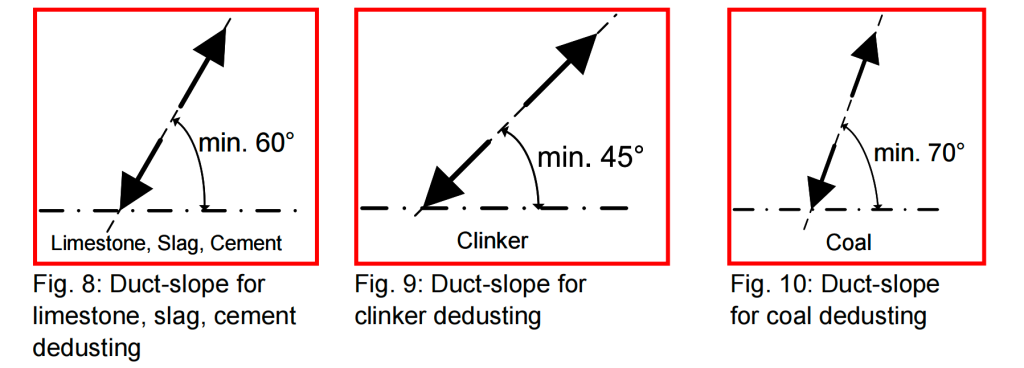
Up- and downward sloping for dust-laden air shall have – to avoid dust accumulation – a
minimum slope of 60° for limestone, slag and cement and 45° for clinker, 70° for coal
measured from the horizontal.
Ductwork in horizontal should be avoided!
For a fan discharge duct, the velocity shall be between 15 and 20 m/s. Silencer to be
provided, if required.
Orifice plates with wear protection shall be used for balancing systems, which handle
abrasive dust (e.g. clinker, slag). All other systems shall have butterfly dampers of a
minimum 6 mm thick plate construction.